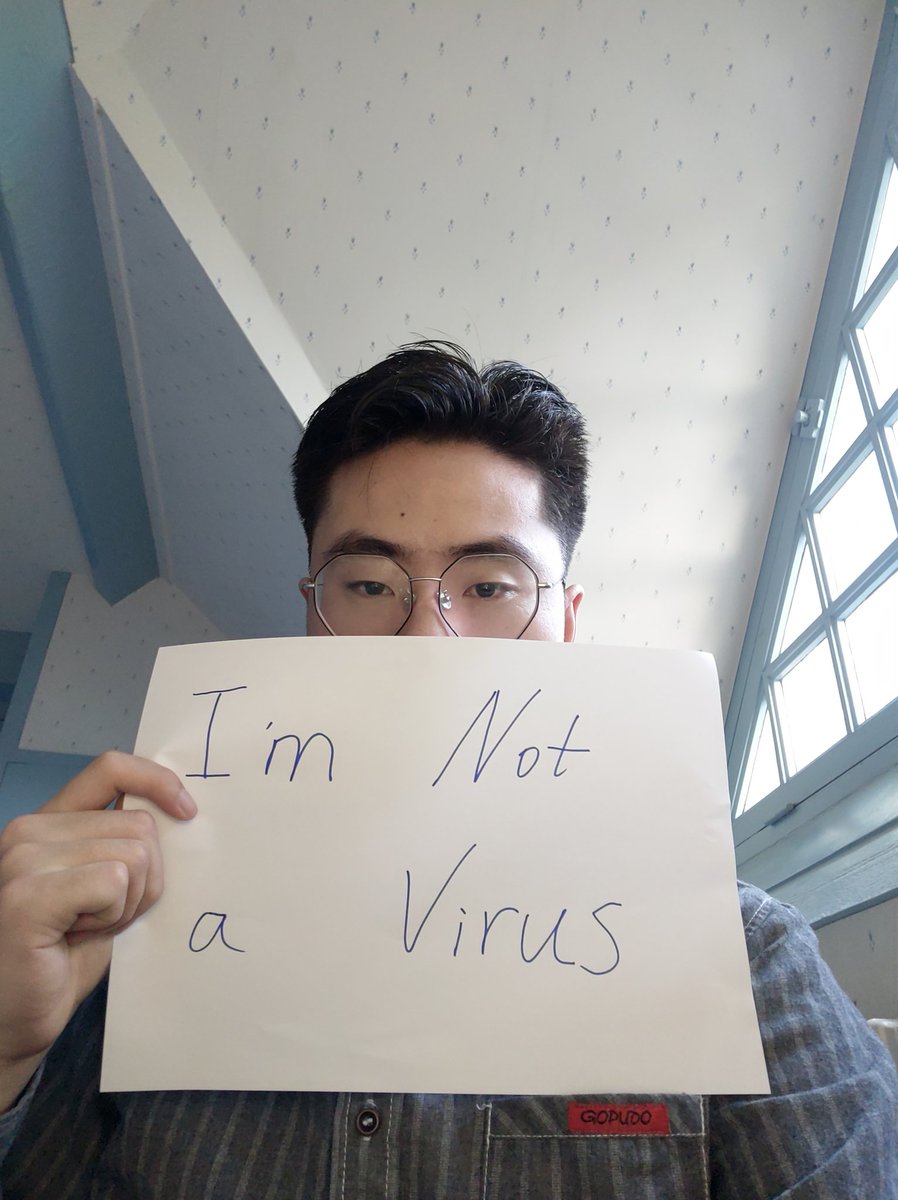
Racism. This week, I’d like you to reflect on and discuss narratives of racism you see surrounding Covid 19. Can you make a connection between any new/emerging narratives of racism and Pham’s discussion of “racial aftertaste”? Or any of her discussions of racism from the chapters we read in Asians Wear Clothes on the Internet? Please be sure to include links and sources to articles you find. Check the New York Times or other major newspapers for articles discussing racism. Email me if you need help.
The coronavirus crisis is causing a wave of racism across the globe. At the beginning of the pandemic, when the state of alarm had not yet been enacted, China was the focus of the world. There were many reported attacks on Asians living in different states of Europe until the Chinese community itself started a campaign on social networks with the hashtag #IAmNotAVirus.
Chinese restaurants without customers, people who move away if they meet an Asian citizen on the street, offensive comments on social media…The xenophobia samples have acquired such magnitude that even the UN Human Rights Office has warned of it in Twitter: “It is understandable to be alarmed by the coronavirus. But there is no fear that it could be a pretext for prejudice and discrimination against people of Asian origin. ”
The coronavirus, which was first detected in China in December, is now spreading across all continents except Antarctica. It has led to a pickup in racist attacks on people with Eastern features in the United States, fueled, experts say, by ignorance of the threat, combined with latent racism and a campaign by the Trump Administration that insists on speaking of “Chinese virus”.
It’s hard to keep track of the number of attacks on Orientals since the coronavirus outbreak, but something like this is what sociologist Russell Jeung, professor of Asian-American studies at the University of San Francisco, is doing. He has been collecting information in the US media about these incidents since January. Between February 9th and March 7th, the media reported 292 incidents. The number increased by 50% from the first week to the fourth.
Now, four months after the start of the pandemic, the Chinese are not the only ones to suffer discrimination. Given the CDC’s recommendation to all Americans about using homemade face wraps in public to help stop the spread of the coronavirus, a conflict arises in the African-American and Latino-American communities.
Trevon Logan, professor of economics at Ohio State University, told CNN: “We have plenty of examples of alleged black male criminality in general, and then we have the advice to go out in public on something that can certainly be read as criminal or nefarious, particularly when applied to black men”.
The use of masks for some communities poses a social risk of segregation and discrimination. Several people of color, activists, academics, and ordinary Americans, expressed fear that homemade masks could exacerbate racial profiling and endanger blacks and Latinos.
People of color have to make conscious decisions every day about how they portray themselves in the world and are perceived by others, especially by the police. Covering their face with a homemade scarf can make living with the rest of society more difficult according to the existing racial stereotypes.
Against this background, the concept of the racial aftertaste is involved in the narrative of information and fashion, if we consider that masks are the top-accessory of the year. “Racial aftertaste” describes aversions to racial alterities, the features, aspects, and bodies. Pham describes “racial aftertaste” as the “souring of public tastes toward what was once a curious novelty and that now threatens to become a permanent feature of the new fashion and media economy.”
White society is developing an unprecedented aversion to Asians, although it could be said that in this context of crisis all stereotypical races will have negative consequences at the social level. An example is the African American society of the United States. Apart from this, the “MADE IN CHINA” label is being affected by the coronavirus crisis, as many consumers do not want to buy objects imported from China due to fear and ignorance of being infected.
Finally, we can say that the new coronavirus pandemic is affecting the entire planet from different points of view. The economic part also linked to the fashion industry is being hurt by a wave of racism that limits the consumer in their purchases and causes society to build other stereotypes associated with vulnerable races.
Despite this, the world, as always, will be able to be reborn in its ashes, as it did in the post-war of the last century.
 A Day in the Life